



What will you walk away with?
The recommendation. The motion to fund first, on one page, with an owner and a date.
Segment and beachhead sizing, with a map of who already occupies the segment.
A pricing structure: the tiers and what each includes.
A channel strategy, with each candidate partner tested against buyer, budget line and buying moment.
The unit-economic gates the company will be measured against.
The funding sequence: what gets funded first, what waits, and what each motion has to prove.
Kill/pivot thresholds, written before the evidence.
If validation is needed, the sample frame, screener, interview guide, scorecard and tracker to run it.
→ Button: Book a 20-minute call → /book
Is this the right engagement for you?
A good fit if two or more of these are true:
A funding gate, board meeting or launch has a date on it
A channel decision is pending: direct, or through partners
Nobody on the team has run a go-to-market before
There's a build, buy or partner question on the roadmap (see Build, buy or partner)
Probably not a fit if:
You already have a fractional CRO or head of strategy in the seat
You need campaigns run. We don't manage paid media.
You need a grant written. We design the application and the evidence it has to carry, and a specialist writer writes it.
Case: when distribution, not product, was the constraint
The engagement. Fractional Chief of Strategy to an early-stage software company selling into small, independent professional practices in a regulated field. The work covered segmentation, positioning, price structure, channel strategy, and the sequencing that decides which motion gets funded first.
What we found. Distribution decided the outcome, not the product. A validation sprint, scoped to force a kill-or-pivot call, showed that the unit economics couldn't carry a direct sales motion at the price point the plan assumed. The go-to-market was redirected toward channel partnerships before the spend was committed.
What we left behind. The unit-economic gates the company is now measured against. A category and competitor map benchmarking direct comparable across four structural models. A decision tree of exit paths with base-rate odds attached. A roadmap covering business architecture, security guardrails, IP ownership, compliance readiness, finance, governance and org design. And a recommendation to pursue a non-dilutive funding route rather than an equity raise, tied to a dated decision gate.
The point. Founders rarely need another opinion. What they need is to see the second- and third-order consequences before the commitments lock in.
Go-To-Market Strategy:
Which motion gets funded first?
A go-to-market strategy is a decision about which sales motion gets funded first: who you sell to, at what price, through which channel, and in what order. Your unit economics set the limits on all four. When a go-to-market plan fails, it's usually because the motion is wrong, not the product. The price point can't pay for a direct sales team, or the channel never reaches the buyer at the moment they buy, or the segment is large on paper and hard to reach in practice.
We run this decision as a GTM Blueprint. It ends with one recommended motion (segment, price, channel and funding order), along with the unit-economic gates it will be measured against. The kill/pivot thresholds are agreed before the first dollar is spent or the first interview is booked.
It's built for early-stage founders who haven't run a go-to-market before, especially those selling into regulated or professional buyers, and for established companies taking a product into a new segment.
What should a go-to-market strategy actually decide?
It should settle four decisions, in this order:
Segment. The beachhead: the specific buyers you can reach, win and serve first, sized from real counts rather than a top-down market figure.
Price. The structure as well as the number: the tiers, whether there's a free entry point, and what each tier includes.
Channel. Direct sales, channel partners, marketplace listings or a mix, chosen according to what the price can pay for.
Sequence. Which motion gets funded first, what waits, and the gate each one has to clear before the next gets money.
The fourth decision is the one that turns a strategy into a budget.
Should you sell direct or through channel partners?
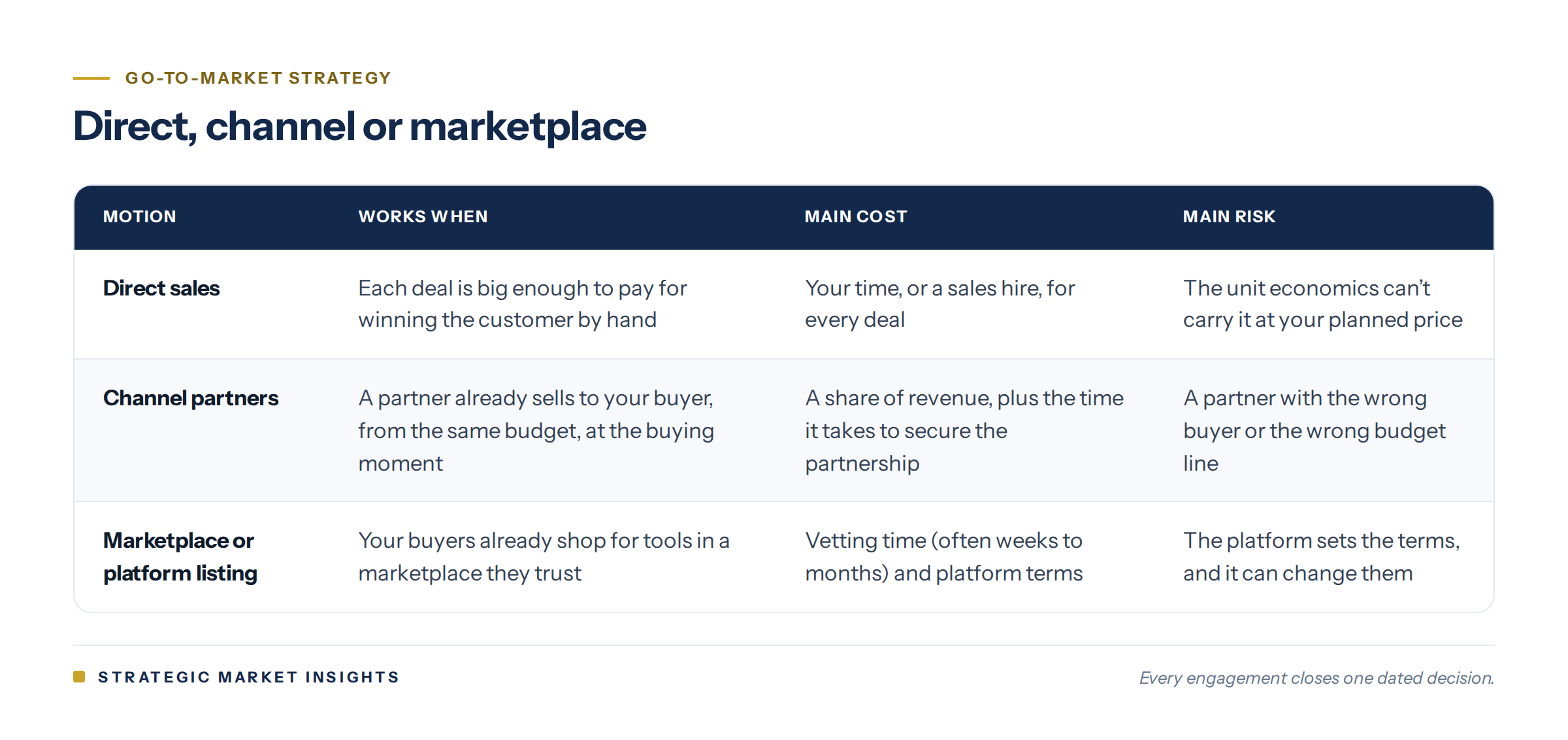
Many companies end up with a mix. The strategy's job is to decide which motion gets funded first and what it has to prove before the next one gets money.
What if your unit economics don't support a direct sales motion?
Then don't fund a direct sales motion, and don't discount your way into one. You have four realistic options:
Move to a channel that already owns the relationship. A partner who already bills your buyer reaches them at the buying moment without you paying for the introduction.
Change the deal size. Rework the package, the tier structure or the target buyer so that each sale can pay for the effort of making it.
Narrow the segment to the buyers who are cheapest to reach and quickest to decide, and prove the motion there first.
Let the product make the first sale. A free or low-cost entry tier can act as the funnel, with paid tiers converting from it.
Whichever you choose, test it before you commit the money. In the case below, a validation sprint showed that the planned direct motion couldn't pay for itself, and the go-to-market was redirected to channel partners before the spend was locked in.
How do you validate a go-to-market before spending on it?
You validate it with primary research designed to force a decision. That means four things: a defined sample of the buyers you intend to sell to, a screener to make sure you're talking to the right ones, a structured interview guide, and a scorecard that turns what they say into numbers. Most importantly, before the first interview you agree the result that would make you kill or pivot the plan.
That last step is what separates validation from reassurance. A threshold written down in advance lets the research prove you wrong. A threshold set afterwards just becomes a way of explaining the result.
How do you set a kill threshold, and when?
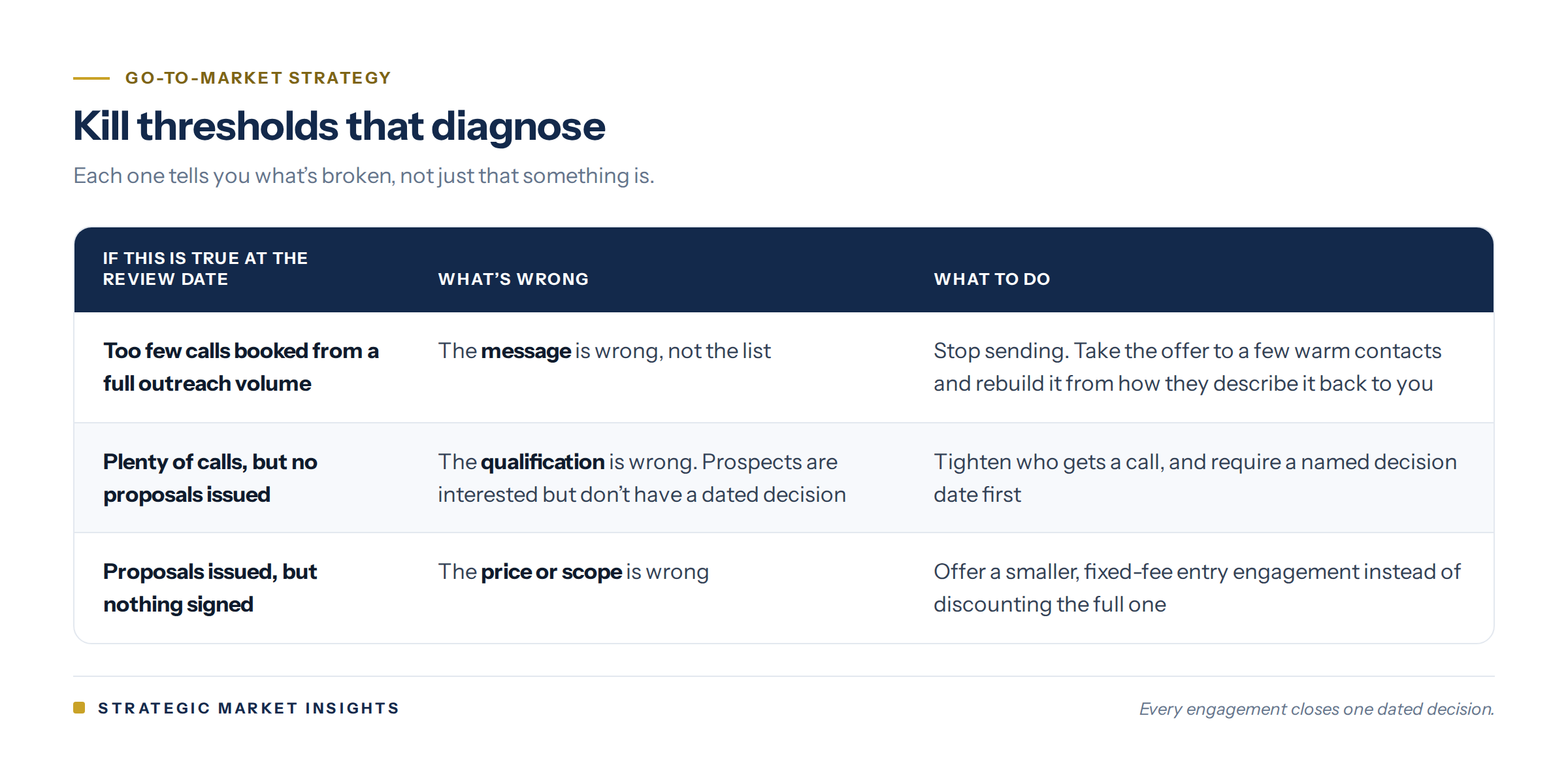
Always before the evidence arrives. If you agree a kill threshold after the data lands, it isn't a threshold anymore. It's a rationalization.
A good threshold names the number, the date and the action. The most useful thresholds are also diagnostic: they tell you what is broken, not just that something is. This is the pattern we use, including on our own go-to-market:

Frequently asked questions about go-to-market strategy
What is a go-to-market strategy?
A go-to-market strategy is the plan for how a product reaches paying customers. In practice it comes down to four decisions: which segment you sell to first, how you price, which channel you sell through, and the order in which those motions get funded. A useful one is constrained by unit economics, so it only recommends a motion the price point can pay for. It should also carry thresholds, agreed in advance, that say when a motion gets doubled and when it gets killed. Without those, the strategy can't be tested, and you can't find out it's wrong until the money is gone.
Who helps early-stage founders figure out their go-to-market before they spend money on it?
A strategy advisor who works on the decision rather than the execution. That means sizing the segment, testing the price, choosing the channel and setting the funding order before a sales hire or a campaign commits the budget. Agencies run campaigns and fractional sales leaders run pipelines, and both are useful once the motion is chosen. The job before that is to pick the motion and prove it can pay for itself, ideally with a validation sprint whose kill/pivot threshold is agreed before the first interview. Strategic Market Insights runs this as a fixed-scope GTM Blueprint.
How do I decide whether to sell direct or through channel partners?
Start from unit economics. Direct sales only works if each deal is large enough to pay for winning it by hand. If it isn't, look for a partner that already sells to your buyer, out of the same budget, at the moment they buy. Those three tests separate a real channel from a partner that merely has a big audience. Direct sales gives you control and faster learning, while channel partners give you reach at the cost of margin and setup time. Many companies start with a small amount of direct selling to learn the buyer, then move volume to a partner once they understand what makes the buyer act.
How do you go to market with software sold to small independent practices?
Treat the owner as the buyer, the user and the budget, because in a small practice they are usually all three. That makes cold direct sales expensive relative to the price such practices will pay. The routes that tend to work reach the owner through someone they already trust at a moment that matters: a professional association, an insurer or vendor that renews with them every year, or a software marketplace they already buy from. Price with a low-friction entry point, and prove the motion on a narrow segment before scaling. In regulated fields, factor in how long any required security or compliance evidence takes to produce.
Should I hire a fractional executive or buy a scoped consulting engagement?
It depends on whether you're filling a seat or closing a decision. A fractional executive runs a function on an ongoing basis, which is right when the strategy is settled and someone has to execute it every week. A scoped engagement closes one dated decision (which segment, which channel, which motion to fund first) and then ends. If you can state the decision in one sentence with a date, scope it. If you have a series of decisions in a row, an ongoing Fractional Chief of Strategy arrangement can make sense, as long as each piece of work still ends in a dated decision rather than an open retainer.
What should be in a go/no-go gate for a product launch?
A go/no-go gate needs four things written down before any evidence is collected: the criterion, the threshold, the date and the person who makes the call. Mark each criterion as gating (fail it and the answer is no) or material (it weighs on the decision but doesn't decide it alone). Test whether the company is ready, not just the product. Ownership, contracts and paperwork, evidence of compliance, and who holds which decision rights all need to be in place. A product can be finished while the company behind it still isn't ready to launch.
Fixed-scope engagement or monthly retainer: which is better for a small company?
A fixed scope is usually better when you have a specific decision to make. You know what you're getting, when you're getting it and what you'll be able to decide at the end, and the engagement stops when the decision is made. An open monthly retainer suits ongoing work, but it has a habit of quietly becoming a headcount line with no defined output. If you do choose ongoing support, insist that each piece of work inside it still produces a dated decision, written down, with an owner. That keeps the arrangement accountable.
How long does a GTM Blueprint take, and what does it cost?
We set the scope and fee after a first call, because the honest answer depends on which decision you're closing and how much evidence already exists: customer interviews, pricing data, conversations with partners. Three things hold regardless. The scope is fixed and has a dated end. The deliverables are named in writing before any money moves. And if the decision doesn't need the full blueprint, we'll say so and scope it down. The 20-minute call is where we find out.
Have a funding gate, board meeting or launch on the calendar?
Bring the decision and the date it has to be made by. In 20 minutes you'll know whether it's scopeable and what it would take to close it. If we're not the right fit, we'll tell you who is.