


Should you open the next location?
A new location is worth opening only if it passes three tests: it wins work you can't already reach, it wins that work at margins at least as good as the ones you have now, and it runs for less than the most it can spend and still clear a profit. Most expansion decisions are made on the first test alone ("there's demand over there") and then fail on the other two.
We run this decision as an Expansion Siting Study. It ends in one of three answers: go, no-go or not yet. With the answer you get a monthly cost ceiling the new location has to live under, a drive-time map showing how much of the new territory you already serve, and the go/no-go thresholds, which we agree with you before any data is collected.
It's built for owner-operated businesses in trades, home services, building supply and distribution that have one to four locations, a named target area, and a lease, hire or vehicle purchase tied to a date.
How does a second location lose money while looking busy?
There are three ways it happens, and a market scan that only counts customers in the new area catches none of them.
Cannibalization. The new location wins jobs your existing crew would have driven to anyway. Revenue moves from one address to another, and you've added rent and a truck to move it.
Margin dilution. It wins genuinely new work, but at worse economics. Thinner territory means more drive time per job, and a two-person crew can't run efficient dispatch. Revenue goes up and profit goes down.
Overhead it can't carry. Rent, vehicles, insurance and licensing add up to more than the crew can contribute at local ticket sizes, however healthy demand looks.
Each of the three gets its own test, and the sections below explain how.

What is a cost ceiling, and why use one instead of a forecast?
A cost ceiling is the most a new location can spend each month on everything except field labor and still clear a real profit.
A forecast asks what the location will cost, and at the moment you have to decide, you usually don't know. A cost ceiling turns the question around. It works backwards from the revenue side (local ticket sizes, realistic job volume, crew utilization, and what one booked job costs to win in that market) to the maximum the location can carry. You then compare real quotes for rent, vehicles and insurance against that maximum, rather than guessing at a forecast.
If the quotes come in over the ceiling, the answer is no, and no amount of demand changes that.
How much of the new territory do you already serve?
Owners rarely think to ask this, and it's the question that most often changes the decision.
We map a drive-time area around your existing location and around the proposed one, at both peak and off-peak traffic, and use the more conservative result. The part of the new area your current crew can't reach in that time is net-new territory. The overlap is territory you already serve, and work won there is redistribution rather than growth.
The map shows how much territory overlaps. To see how much revenue would actually move, we use your own job records: how much work you already deliver into the new area today. In the case below, this one question changed what the client was deciding.
What decides go or no-go?
We use six criteria, weighted. If a gating criterion fails, the answer is no whatever the others say.
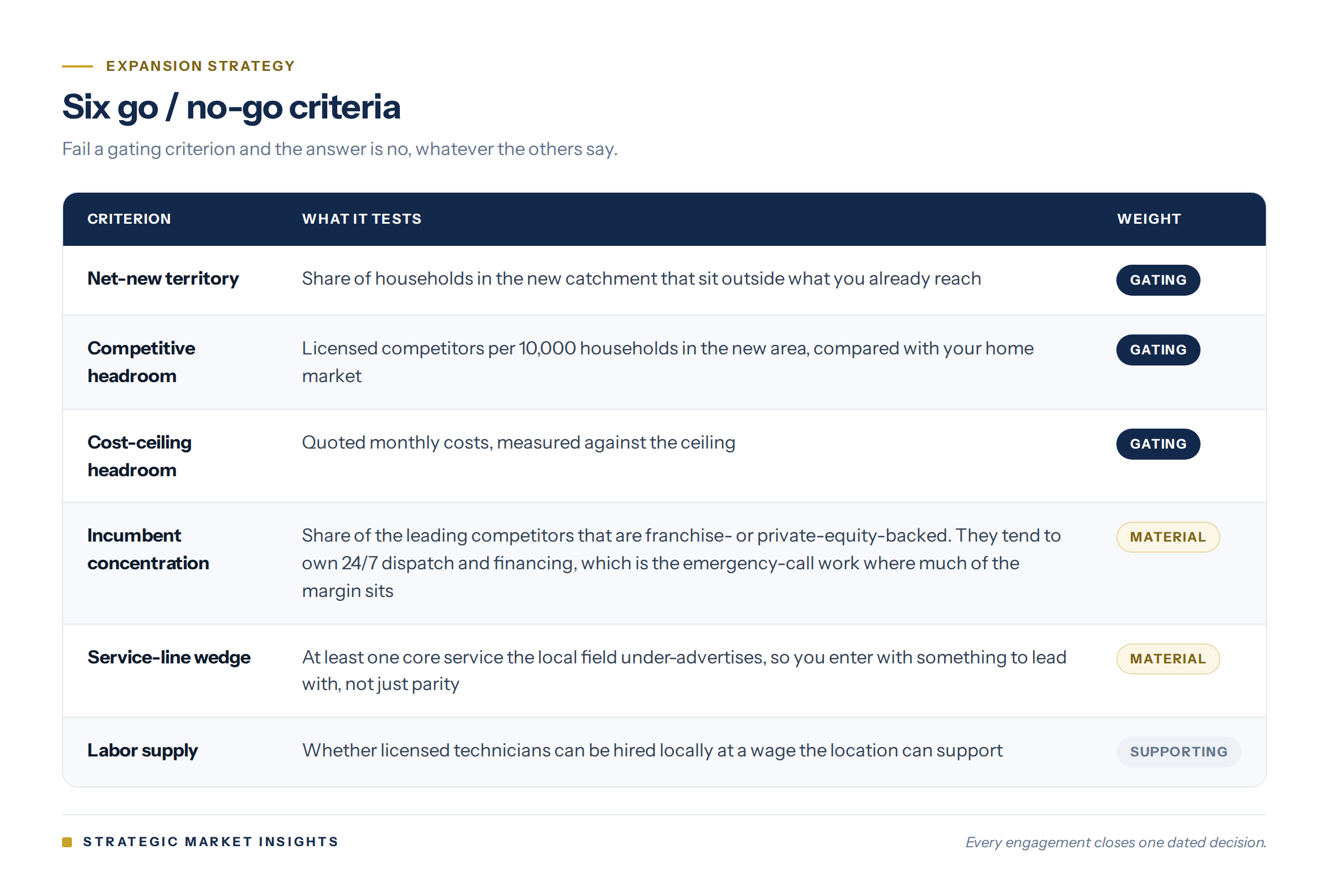
Two rules keep the evidence honest. Where the state publishes a contractor-license register, the competitor set comes from the register rather than from review sites, so a firm counts only if it holds an active license, and we never infer ownership from a company name. The thresholds are proposed by us and agreed by you before collection starts. If a threshold is set after the data arrives, it's no longer a test.
What will you walk away with?
The recommendation. Go, no-go or not yet, on one page, with an owner and a date.
A monthly cost ceiling for the new location.
A territory-overlap map showing net-new versus already-reachable households, built from drive-time analysis.
The competitor field. Licensed firms, density per household, ownership signals and the services each one advertises.
The go/no-go criteria and thresholds, agreed before any data was collected.
The triggers that would change the answer later, such as a rent quote, a hire that falls through or a new competitor entering the area.
Is this the right engagement for you?
A good fit if:
You own or run a business with one to four locations
You have a specific target area in mind
A lease, a hire or a vehicle purchase is tied to a date
You can't yet say what the new location would cost per month. That's normal, and it's the problem this engagement is designed to solve.
Probably not a fit if:
The location is already decided and you need it promoted. That's an agency's job, and we don't manage paid campaigns.
A franchise agreement dictates where you can open.
Buying a competitor instead of opening a location? The same tests apply. See the FAQ below and Build, buy or partner.

Frequently asked questions about opening a second location
Should I open a second location for my business?
Open it if three things are true. First, most of the new area's households sit outside what your current location already reaches. Second, you can win work there at margins at least as good as your existing ones. Third, the new location's monthly costs, excluding field labor, come in under its cost ceiling. If any one of those fails, demand in the new area won't rescue the decision. The most common mistake is to test only the first, by counting potential customers in the new area, when the money is usually lost on overlap and overhead.
How do I know how much a second location can cost to run and still be profitable?
Work backwards from revenue instead of forwards from costs. Start with realistic ticket sizes for the new area, the job volume a crew of your planned size can deliver, a utilization rate you can defend, and what it costs to win one booked job in that market. From those you can derive the most the location can spend each month on rent, vehicles, insurance, licensing and other overhead and still clear a real profit. That figure is the cost ceiling. Then get real quotes and compare them against it. If the quotes come in over the ceiling, don't open.
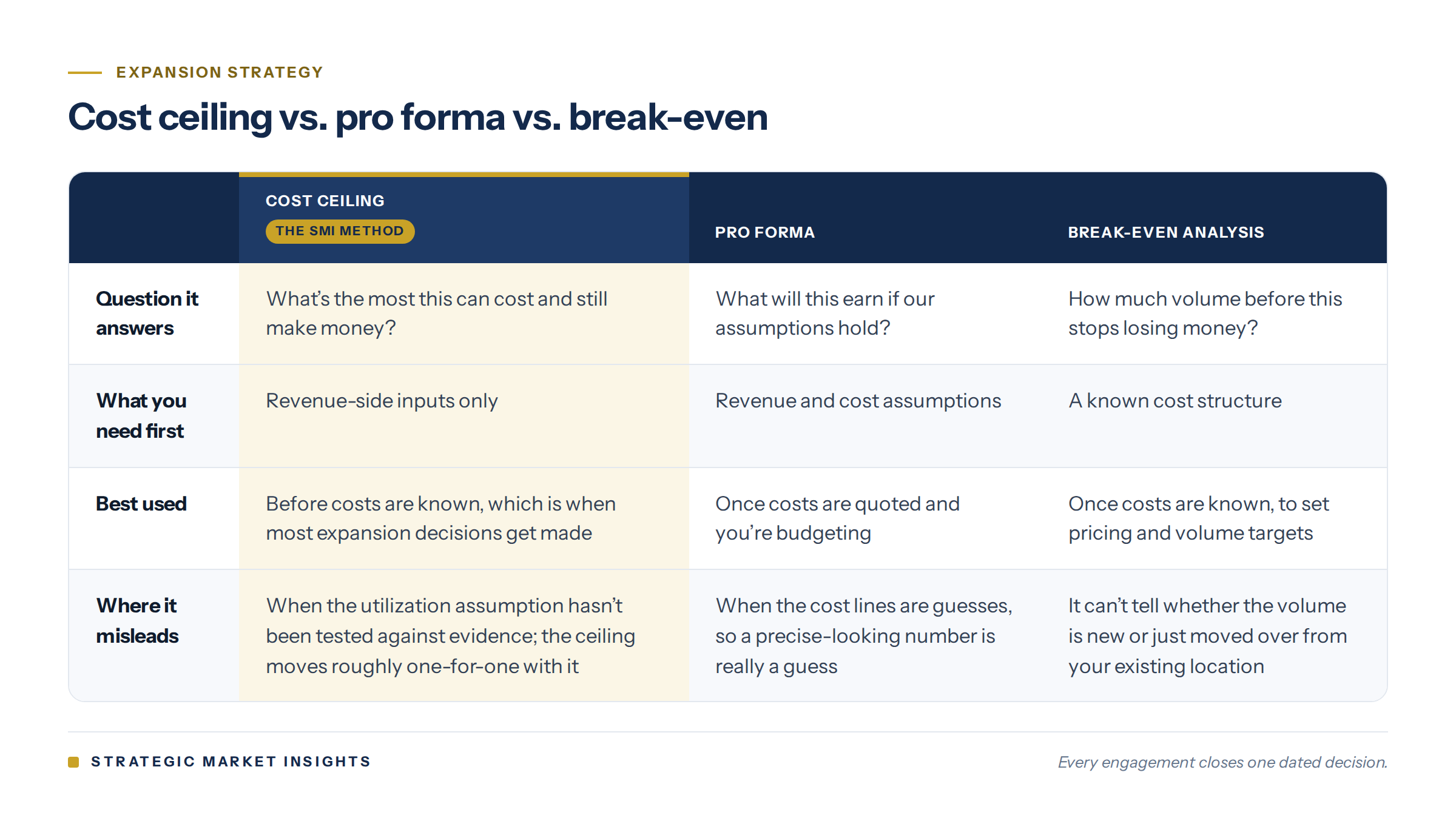
Cost ceiling vs. pro forma vs. break-even analysis: when do you use each?
Use a cost ceiling before you know your costs, which is when most expansion decisions are actually made. It tells you the most the location can cost and still make money. Use a pro forma once costs are quoted and you're building the budget; it projects what the location will earn if your assumptions hold. Use break-even once the cost structure is known, to set volume targets and pricing. For expansion, break-even has one blind spot: it can't tell you whether the volume that gets you there is new business or work that simply moved over from your existing location.
How do I figure out how much of a new service area I already cover?
Draw drive-time areas (isochrones) around your current location and the proposed one, using traffic-aware routing at both peak and off-peak times, and keep the more conservative result. The overlap between the two areas is territory you already serve, and everything outside it is net-new. Then check your own job records for how much work you already deliver into the new area. The map shows how much territory overlaps, and your job history shows how much revenue would simply move rather than grow.
What should I know before signing a lease for a second branch?
Know three numbers before you sign: the location's monthly cost ceiling, the share of its catchment that's genuinely net-new, and what it costs to win one booked job in that market. Beyond those, find out three more things. Are the leading local competitors franchise- or private-equity-backed? They usually hold 24/7 dispatch and customer financing. Is there a service line the local field under-serves that you could lead with? And can you hire licensed technicians there at a wage the location can pay? The lease is the hardest of these commitments to reverse, so sign it last.
How do HVAC, plumbing and other contractors decide on new service areas?
The strongest decisions treat it as a territory question, not an advertising one. Map drive time from each location rather than drawing a radius, because traffic decides what a crew can actually reach. Count licensed competitors per household from the state's contractor-license register where there is one, not from review sites. Check who owns the leading competitors, because franchise and private-equity-backed firms tend to hold the emergency-call work, where much of the margin sits. Then test the economics against a cost ceiling, because a new area can look busy and still lose money.
We're thinking of buying a competitor instead of opening a location. Does this still apply?
Yes. An acquisition has to pass the same three tests: net-new territory, margins at least as good as yours, and overhead under the ceiling. On top of those, you have the deal itself to assess. We'd pair the siting work with a Diligence Red-Flag Review, which looks for whatever would break the deal before you sign it. Our Build, buy or partner page covers how to weigh buying against building the capability yourself. We don't give legal counsel on deal terms, but we'll tell you where you need it and what it has to cover.
How long does an Expansion Siting Study take, and what does it cost?
We set the scope and fee after a first call. The honest answer depends on how much evidence already exists: whether you have job data for the area, whether the state publishes a license register, and how far along the site search is. Three things hold regardless. The scope is fixed and has a dated end. The deliverables are named in writing before any money moves. And if the decision doesn't need the full study, we'll tell you and scope it down. The 20-minute call is where we work out which of those applies to you.
Have a lease, a hire or a truck purchase on a date?
Bring the location and the date you have to decide by. In 20 minutes you'll know whether the decision is scopeable and what it would take to close it. If we're not the right fit, we'll tell you who is.