

Build, buy or partner: how do you make the call?
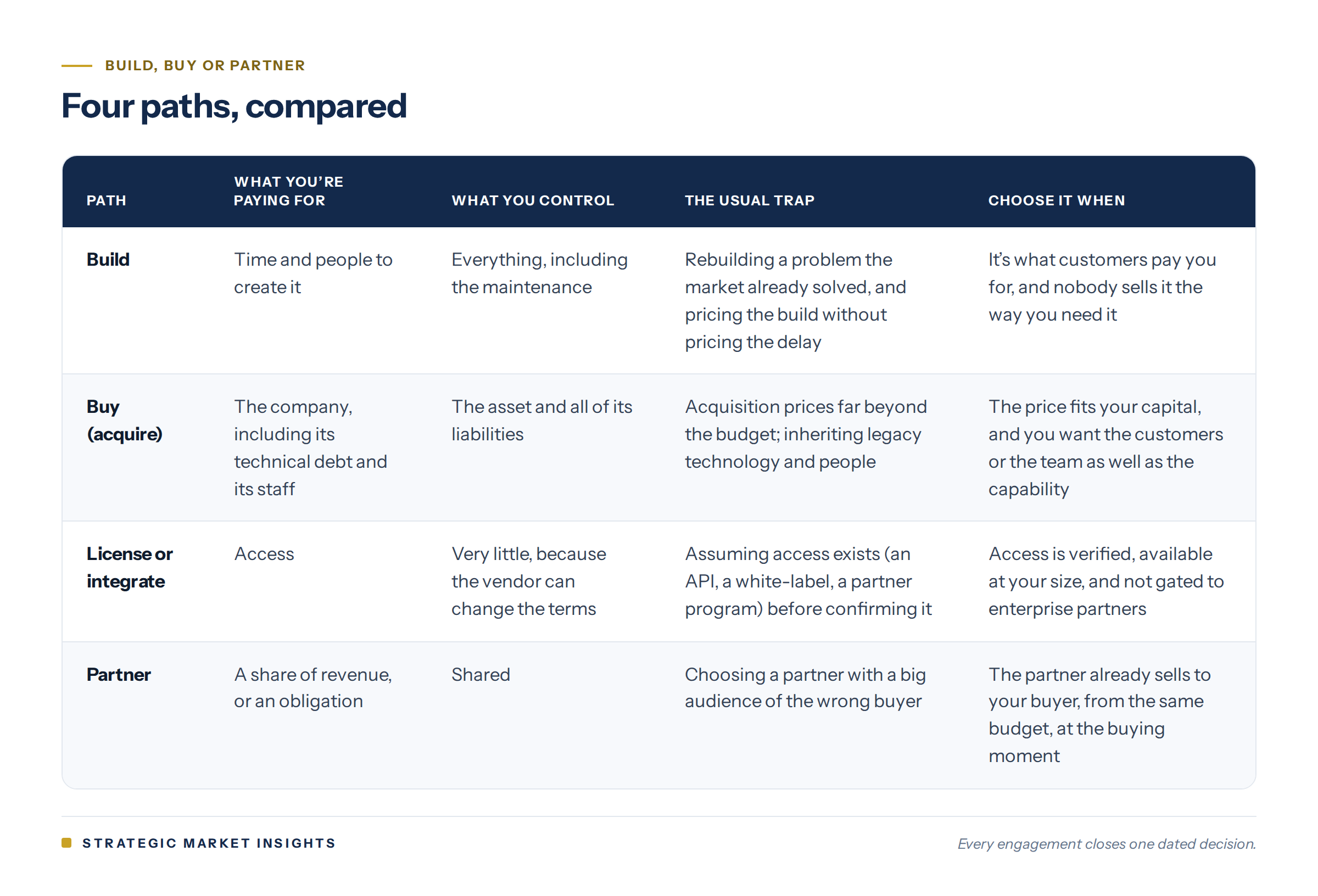
Build when the capability is the thing customers pay you for and nobody sells it the way you need it. Buy or license when it's a solved problem and access genuinely exists at a price you can carry. Partner when someone else already owns the buyer relationship, the channel or the buying moment you need. Most companies go wrong in one of two directions: they build something the market has already solved, or they plan around buying access that turns out not to exist.
We run this decision as a Build, Buy or Partner Review. It ends with one path, chosen from costed options that show what each would cost, how long it takes to go live and what it would lock you into. You also get the condition that would reopen the decision, agreed before the evidence is in.
It's built for early-stage founders with a build-vs-buy question on the roadmap or a platform they depend on, and for owner-operators weighing an acquisition against building the capability themselves.
How do you actually decide between build, buy and partner?
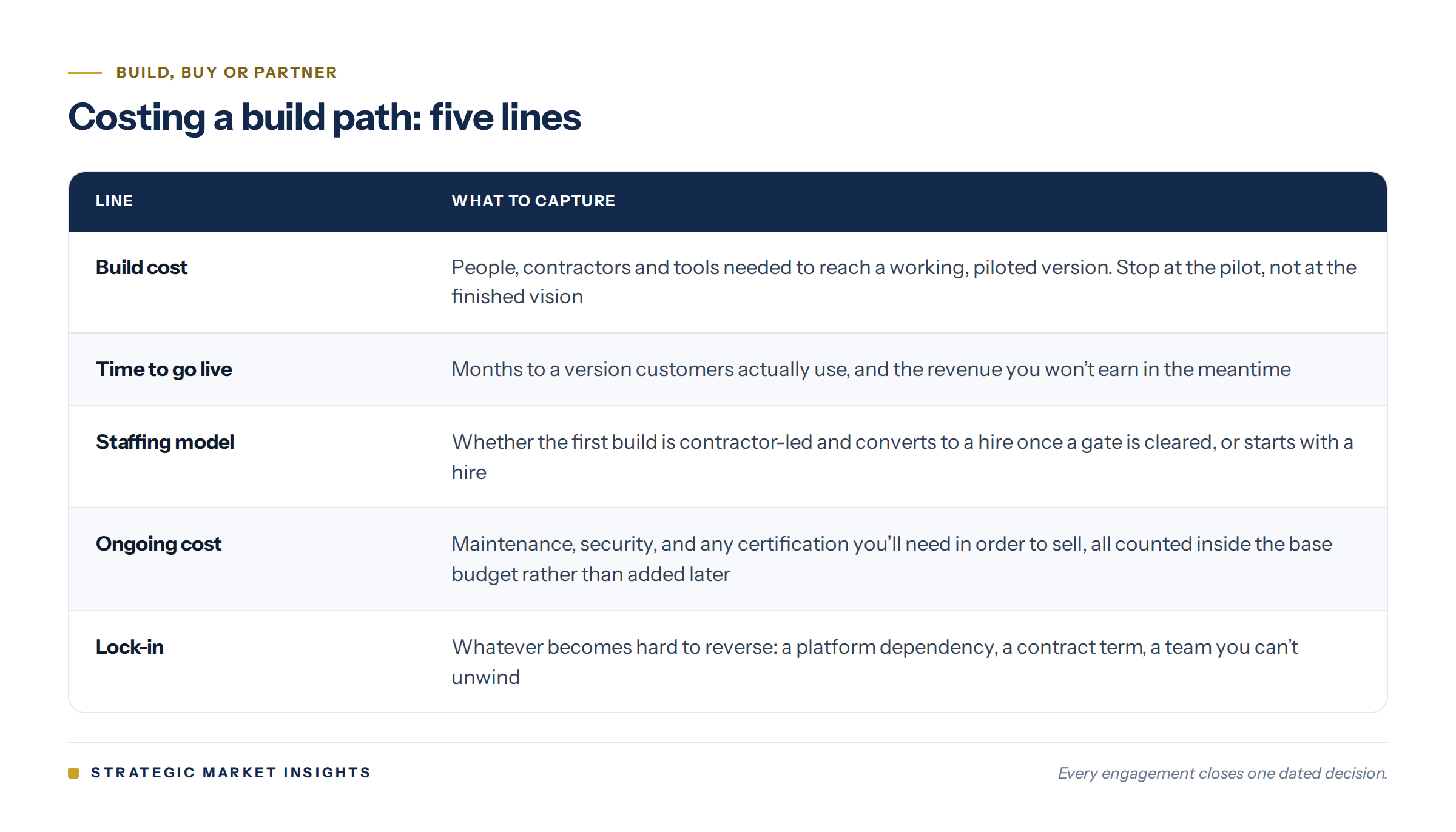
How do you cost a build path before committing to it?
Cost it on five lines, and put all five on the same page as the alternatives.
Is this the right engagement for you?
A good fit if:
A build-vs-buy question is on your roadmap, with a funding gate, board meeting or launch date attached
Your product depends on a platform you don't control
You're weighing an acquisition against building the capability yourself (see also Expansion strategy)
You're choosing between a distribution partner and your own sales team (see also Go-to-market strategy)
Probably not a fit if:
You need the product built. We don't do engineering delivery, which also means we gain nothing if you decide to build.
You need legal review of license or deal terms. We'll tell you where counsel is needed and what it has to cover, but we don't provide it.
Case: buy access, not a company
The engagement. As Fractional Chief of Strategy to an early-stage software company, we worked on a product that had to coexist with an incumbent platform its customers already used. There were four options on the table: acquire a platform, license access to one, build an equivalent, or build something narrower that works alongside it.
What we found. Acquisition was out of reach. Even the smallest realistic target was priced at five or more times the company's entire planned raise. Licensing wasn't a real option either, because the incumbent offered no public integration path to a company that size, only partner-gated access. And building an equivalent platform meant rebuilding something a dozen vendors had already solved, at roughly four times the cost and four times the time of the alternative.
The recommendation. Don't buy the company and don't build the platform. Build only the differentiating layer, designed to work alongside whatever customers already use, so that it never depends on access it doesn't have. Staff the first build with a contractor, and partner for distribution with the party that already owns the customer's renewal relationship.
The point. The expensive mistake was hiding in the option that looked most ambitious. Costing all four options side by side made that visible before any money was committed.
-
Write down the one thing customers pay you for. Everything else is a candidate to buy or partner for. If that list of "must build" items is long, the build is probably too big.
-
Put the cost to build or buy, the time to go live, the ongoing cost and the lock-in side by side. The cost of delay counts too, because revenue you don't earn while a build is underway is part of what the build costs.
-
A license or integration path only exists if the vendor offers it, today, to a company your size. "They have an API" often turns out to mean a partner-gated program for enterprise customers. Confirm access before it goes into a plan.
-
A partner is only a channel if it already sells to your buyer, out of the same budget, at a moment that matters to the purchase.
-
Before you commit, write down what would send you back to the table: a vendor opening its API, a target's price falling, a partner changing its terms.
-
The answer is often a sequence rather than a single path. Build only the differentiating layer first, partner for distribution, and buy or license the rest later, once revenue justifies it.
When is a partnership actually a channel?
A partnership becomes a channel only when it passes three tests. If it fails any one of them, you have an audience, not a channel.
Same buyer. Does the partner sell to the person who signs for your product, rather than just someone in the same organization or industry?
Same budget line. Does your product come out of the budget the partner already touches? A consumer subscription and a business software budget are decided by different people, at different times, for different reasons.
The buying moment. Does the partner reach your buyer at a moment that matters to the purchase, such as a renewal, an audit or an annual review? The strongest channels tend to be the ones that already bill your buyer every year.
What will you walk away with?
The recommendation. Build, buy, license or partner, or the sequence of them, on one page with an owner and a date.
A costed options table showing, for each path, the cost, time to go live, ongoing cost and lock-in.
An access check confirming whether each buy or license path actually exists at your size.
A partner-fit assessment of each candidate against buyer, budget line and buying moment.
A build sequence with priced staffing options.
The condition that reopens the decision, written down before you commit.

Frequently asked questions about build, buy or partner decisions
Should we build, buy or partner?
Build the thing customers pay you for, as long as nobody sells it the way you need it. Buy or license anything that's a solved problem, but only once you've confirmed the access exists at your size and price. Partner when someone else already owns the relationship with your buyer and reaches them at the moment they buy. In practice the answer is often a sequence rather than a single path: build the differentiating layer first, partner for distribution, and license or buy the rest once revenue justifies it. Whatever you choose, write down in advance the condition that would reopen the decision.
What kind of consultant helps a startup decide whether to build, buy or partner?
Look for a strategy advisor who costs every path and has no stake in which one you choose. The development shop that would do the build and the vendor that would sell the license are both useful sources of information, but neither is neutral. A good advisor will verify that the buy or license options actually exist at your size, test each partner against your buyer and budget, and cost the build to a working pilot rather than to the finished vision. The output should be one recommendation with an owner and a date, not a list of pros and cons.
When does licensing or white-labeling make more sense than building?
Licensing makes sense when three conditions hold. The capability isn't your differentiator. The vendor offers access publicly, today, to a company your size. And the terms leave you room to operate if they change. The second condition is the one most often assumed rather than checked, because many platforms that "have an API" reserve it for enterprise or approved partners. If access isn't confirmed, don't put it in the plan. Design the product so it works without that access, and treat licensing as a later upgrade once revenue justifies it.
When is buying a company better than building the capability?
Buying wins when the price fits your capital and you want what comes with the company (its customers, its team, its position in a market) as well as the capability itself. It loses when acquisition prices run far beyond your budget, which is common, because even small software companies are valued as a multiple of their revenue. It also loses when you'd inherit technical debt and staff you don't need. For owner-operators, buying a competitor has to pass the same tests as opening a location: net-new territory, margins at least as good as yours, and overhead the business can carry.
How do regulated-industry startups find their first channel partners?
Start with the organizations that already hold a trusted, recurring relationship with your buyer, especially one tied to renewals, audits or compliance. Professional associations, the insurers and vendors that bill your buyer every year, and the software marketplaces your buyers already use are the usual candidates. Test each one on three points: does it sell to the person who signs for your product, is your product paid for out of the budget it already touches, and does it reach your buyer at the buying moment? Marketplace listings can be a useful second track, but they tend to be slower, because partner vetting can take weeks to months.
Should an early-stage company use contractors or hire engineers for the first build?
For the first build, a contractor is often the better start: a defined scope, a working pilot, and no long-term salary commitment before you know the product works. Convert to a full-time hire once the build clears a gate you agreed in advance, such as a pilot with real users or a compliance review. What matters is that the staffing model is priced alongside the build options instead of decided afterwards, because it changes both the cost and the time to go live. Pricing several staffing options side by side usually reveals the cheapest credible path.
Can a build, buy or partner decision be combined with go-to-market work?
Often it should be. The choice to partner is frequently the channel decision in disguise: if the best route to your buyer runs through a partner who already reaches them, that shapes what you build, as well as how you sell it. We scope the two together when the decisions depend on each other and separately when they don't, and every engagement still ends in one dated recommendation. The Go-to-market strategy page covers the sales-motion side of that decision.
How long does a Build, Buy or Partner Review take, and what does it cost?
We set the scope and fee after a first call, because they depend on how many paths are really in play and how much evidence already exists. Three things hold regardless. The scope is fixed and has a dated end. The deliverables are named in writing before any money moves. And if the decision doesn't need a full review (sometimes one access check settles it), we'll tell you and scope it down. The 20-minute call is where we find out which kind of decision you're facing.
Have a build, buy or partner call on the roadmap?
Bring the options you're weighing and the date you have to decide by. In 20 minutes you'll know whether the decision is scopeable and what it would take to close it. If we're not the right fit, we'll tell you who is.